
Overview: This article guide explains how optometrists and distributors can pick an auto lensmeter in 2026. It covers what to check, why a 0.01 D display is not proof of accuracy, how an auto lensmeter compares with a manual lensmeter, and where Gaowei Vision’s AL-1000 and AL-1200 fit.
Automatic lensmeter measure sphere, cylinder, axis, attached light (ADD) and prism, then prints or exports the result. Choose by lens types supported, repeatability, speed, data output and service, not by display resolution. Gaowei Vision’s AL-1000 and AL-1200 suit clinics and optical shops that verify lenses daily.
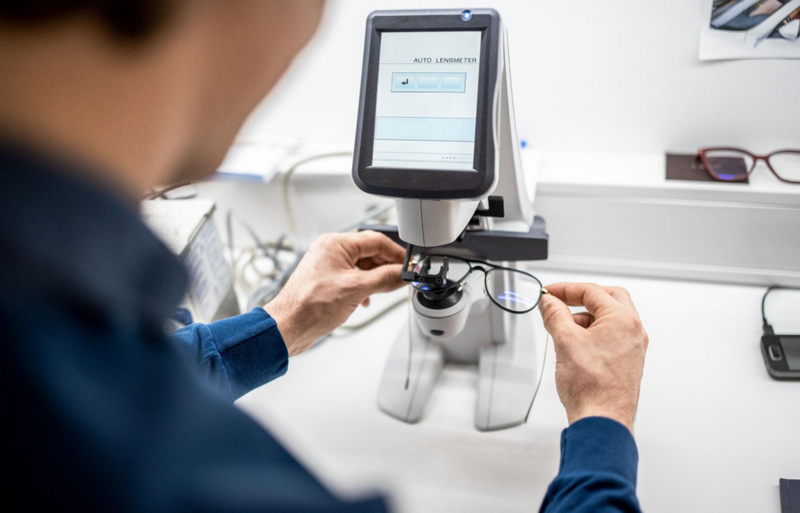
What Should an Optometrist Look For in an Auto Lensmeter?
One optometrist should look for high measurement precision (ideally meeting the ISO 8598 international standard with sphere accuracy around ±0.06 D or better), broad measurement ranges, and full-spectrum lens analysis capabilities when choosing an auto lensmeter.
Key Features to Evaluate
- Measurement Range: Look for a wide cylinder range (at least ±10 D or broader), 1-degree axis readout steps, and a prism range of at least 10 prism diopters.
- Accuracy & Compliance: Ensure the unit meets ISO 8598 standards for vertex power accuracy (typically ±0.06 D or tighter for sphere/cylinder).
- Advanced & Specialty Metrics: Modern auto lensmeters frequently include built-in UV transmission testing, blue-light blocking measurement, and contact lens measurement modes.
- Lens-Type Recognition: The device should automatically detect and measure single-vision, bifocal/multifocal, toric (astigmatism), and progressive addition lenses (PALs) with minimal operator intervention.
- Wavefront / Hartman Sensor Tech: Look for multi-point sensor technology (such as Hartmann grid or wavefront analysis) that delivers fast, operator-independent repeatability.
- Workflow & Connectivity: Consider touch-screen size (e.g., 5.7-inch or larger high-resolution LED), internal thermal printers, data storage/memory, and EMR or digital phoropter/edger integration (such as RS-232, USB, or wireless networking).
- Brand & Support: Invest in reliable ophthalmic manufacturers known for service and calibration backing (such as Gaowei Vision, LINKEYE, Topcon, Nidek, Reichert, or Visionix).
Why Does a 0.01 D Display Not Prove Accuracy?
Because display resolution and measurement accuracy are different things.
The ANSI Z80.1 commentary published by 20/20 magazine makes the point plainly: digital readouts to 0.01 D remove the guesswork of reading a manual power drum, but they do not make a unit more accurate. For standard low-cost focimeters measuring within ±5 D, errors up to 0.06 D are generally accepted.[3]
ISO 8598-1 covers vertex power, cylinder axis, prismatic power and prism base setting, and includes test procedures for non-symmetric error and repeatability in automated focimeters.[2] Ask any supplier how their unit performs against those checks.
- Repeatability across ten readings of the same lens
- Results on high-power and progressive lenses
- Reference lens calibration records
Auto Lensmeter vs Manual Lensmeter: Which Fits Your Clinic?
High volume favors automatic; low volume and tight budgets keep the manual in play.
| Factor | Auto lensmeter | Manual lensmeter |
|---|---|---|
| Operator skill | Low; software aligns and recognizes the lens | Higher; reading depends on the operator’s eye |
| Speed | Seconds per lens | Slower, especially for progressives |
| Records | Print or export | Handwritten |
| Initial cost | Higher | Lower |
| Best for | Busy clinics, chains, labs | Backup, teaching, small shops |
Keep a manual lensmeter as backup if budget allows. My bias: a clinic that checks more than a handful of pairs a day gets its money back in staff time with an auto lensmeter.
When Is a Manual Lensmeter the Better Call?
Three cases come up. A teaching lab where students must learn to read a power drum. A small shop that verifies a few pairs a week. A second station as insurance when the automatic unit is down for service. Outside those, most practices lose time on hand readings and hand-written notes.
Where Does Lensmeter Demand Come From?
At least 2.2 billion people live with a near or distance vision impairment, and uncorrected refractive error remains a leading cause in every country.[1] Every pair of glasses dispensed to fix that needs verifying, which keeps the lensmeter among the busiest instruments in any practice.
Gaowei Vision Auto Lensmeter Models: AL-1000 and AL-1200
Both models appear in the Gaowei Vision auto lensmeter range, which also lists the AL-360 and AL-800.
| Feature | AL-1000 | AL-1200 |
|---|---|---|
| Display | 7-inch capacitive touch | 7-inch touch LCD |
| Lens types | Single, progressive, contact | Progressive, polarized, high-index, contact |
| Extras | PD, pupil height, channel length, UV and blue light | Distance and height measurement |
| Measuring speed | 0.1 second | Not listed |
| Connectivity | Bluetooth, USB, RS232, WiFi | Not listed |
| Printer | Built-in thermal | Not listed |
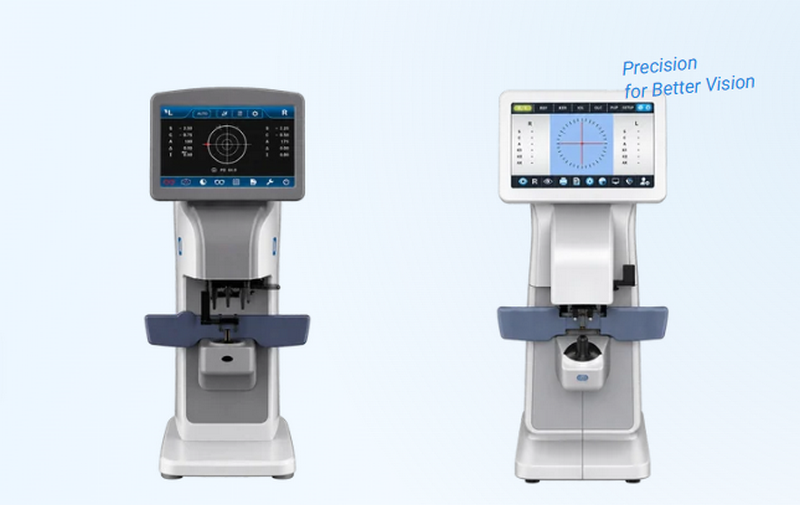
The AL-1000 accepts lenses from Φ12 to Φ112 mm and a PD range of 40–90 mm.[4] The AL-1200 uses a Hartmann measurement system and lists sphere to ±25 D and cylinder to ±10 D.[5] Gaowei Vision lists ISO 9001, ISO 13485, CE and FDA certification and a one-year warranty; confirm certificates for your exact model and market.
How to Verify an Auto Lensmeter Before You Buy
Ask for proof, then test with your own lenses.
Supplier documents
- Model-specific certificates
- Calibration procedure in writing
- Spare parts and thermal paper costs
Your own test
Send a video call request or sample lenses. Measure a few single vision, progressive and high-power lenses you already know, and compare. Voltage and plug type should match your country before shipping. A supplier that answers these questions quickly usually supports the machine well after delivery.
Best Pick: Which Auto Lensmeter Should You Buy?
Need PD, pupil height, UV and blue light checks plus wireless data in one unit? The AL-1000 is the stronger fit. Need a Hartmann system for progressive, polarized and high-index lenses? Look at the AL-1200. Distributors can ask about OEM options and mixed-model orders. Browse the range or request a quote for an auto lensmeter.
FAQ
What is an auto lensmeter used for?
An auto lensmeter is an electronic instrument used by eye care professionals to quickly and accurately measure the optical prescription and properties of eyeglass lenses and contact lenses.
Is an auto lensmeter more accurate than a manual lensmeter?
An auto lensmeter offers higher precision and repeatability, while a well-maintained manual lensmeter matches it in raw accuracy for standard prescriptions.
Does a clinic still need a manual lensmeter?
Not required, but useful as a backup and for training.
Which Gaowei Vision model measures UV and blue light?
The AL-1000 lists UV and blue light measurement.
How often should a lensmeter be checked?
A lensmeter (or lensometer) should have a quick accuracy check at the start of every working day, and a professional overhaul and calibration every 12 to 15 months (or at least every 6 months depending on usage and guidelines).
References
[1] World Health Organization. Blindness and vision impairment. Fact sheet.
[2] International Organization for Standardization. ISO 8598-1:2014 Optics and optical instruments — Focimeters — Part 1: General purpose instruments. 2014.
[3] 20/20 magazine. Focimetry Issues, Part One. Commentary on the ANSI Z80.1 revision.
[4] Gaowei Vision. AL-1000 Digital Auto Lensmeter. Product specifications page.
[5] Gaowei Vision. High-Precision AL-1200 Auto Lensometer. Product specifications page.


