
If you are choosing between a budget and premium auto lensmeter, start with your workload, lens mix, and service needs. Budget models usually cover routine checks. High-intensity use, complex progressive lens detection or scenarios requiring data interconnection records, high-end models often have value.
This guide compares performance, ownership costs, features, and Gaowei Vision models.
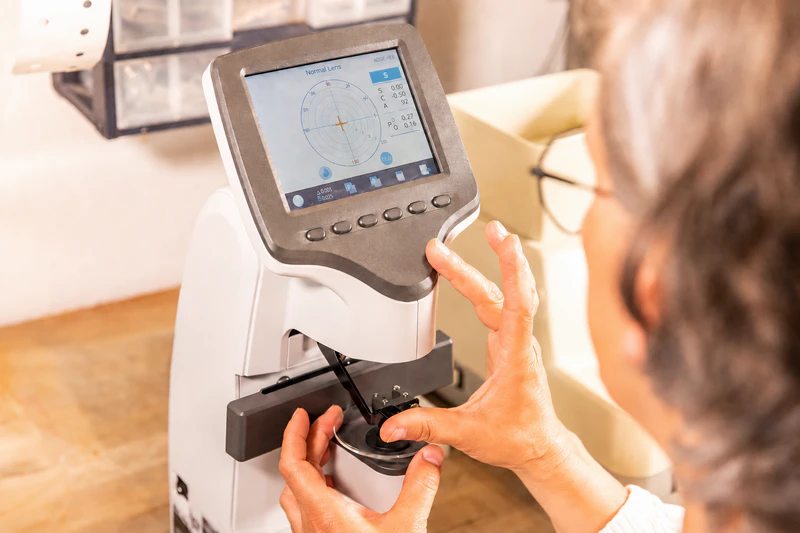
WHAT DOES AN AUTO LENSMETER DO?
An auto lensmeter digitally measures the exact prescription and optical properties of eyeglass and contact lenses.The instrument is also known as a focimeter. ISO 8598-1:2014, published in September 2014, sets requirements and test methods for general-purpose focimeters used to measure vertex power, cylinder axis, and prism.
What It Measures
- Cylinder and axis: Measures astigmatism strength and its angle or orientation.
- Sphere power: Corrects nearsightedness or farsightedness.
- Prism: Detects prism correction used for eye alignment issues.
- Addition (Add) power: Finds the reading power in bifocal and progressive lenses.
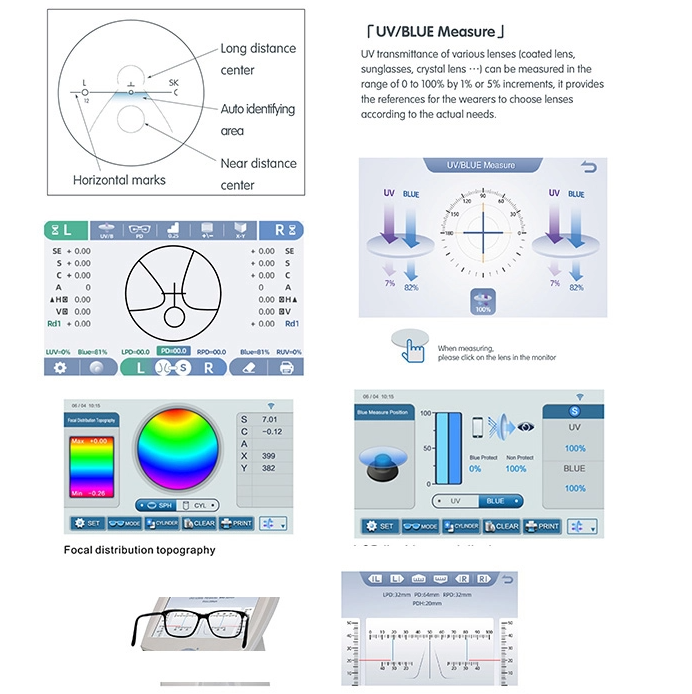
- Extra features: Tests UV protection, blue light filtering, and pupillary distance (PD).
How It Works
- Automatic detection: You place a lens on the sensor, and the machine shines a light beam through it.
- Digital analysis: Internal sensors and computer software analyze the refracted light instantly.
- Clear results: The exact prescription values show up on a digital screen or print out on paper in seconds.
BUDGET VS PREMIUM: WHAT IS THE REAL DIFFERENCE?
There is no formal price line separating budget and premium equipment. In practice, the difference often appears in workflow, lens recognition, connectivity, training, and after-sales service.
| Buying factor | Budget model | Premium model |
|---|---|---|
| Routine lenses | Usually sufficient | Also suitable |
| Progressive lenses | May need more operator input | Often provides clearer guidance |
| Data handling | Manual entry may be required | More connection options may be available |
| Service | Basic support | Faster or broader support may be included |
| Best fit | Low to moderate volume | High volume or complex work |
Do not assume a higher price guarantees better measurements. Likewise, do not assume an affordable unit lacks useful functions. Compare the specification, then test the machine with the lenses your business handles every day.
HOW SHOULD YOU COMPARE MEASUREMENT QUALITY?
Start with a practical demonstration.
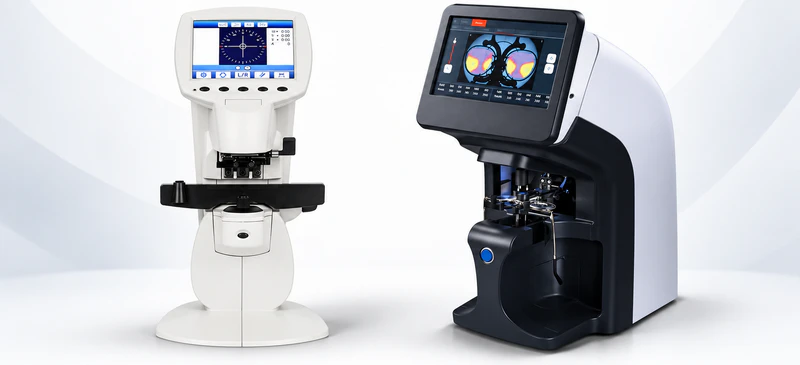
- Test repeatability. Measure one lens, remove it, place it again, and repeat the process. The readings should remain stable.
- Use difficult samples. Include progressive, high-index, tinted, polarized, and high-power lenses where relevant.
- Check every value. Compare sphere, cylinder, axis, addition, and prism rather than looking at sphere alone.
- Ask about verification. Request the stated accuracy limits, checking procedure, and suitable reference lenses.
- Watch the operator. A machine has little value if staff struggle to position lenses or interpret the display.
WHY REPEATABILITY IS NOT ENOUGH
A machine can repeat the same wrong value. Therefore, repeatability should be checked alongside known reference lenses and the manufacturer’s verification procedure. Ask what happens when a check fails, who can adjust the unit, and how long service normally takes.
WHEN IS A BUDGET MODEL THE BETTER VALUE?
A budget model is a sound choice when the daily workload is predictable and advanced functions would sit unused.
- Most jobs involve single-vision and standard progressive lenses.
- Measurement volume is low or moderate.
- Staff are comfortable recording results manually.
- Local or remote technical support is readily available.
- The included warranty covers likely faults and parts.
However, compare like with like. Printers, data cables, software, delivery, import charges, training, and extended warranty terms can turn a low initial quote into a less attractive deal.
WHEN IS A PREMIUM MODEL WORTH THE EXTRA COST?
Premium equipment earns its place when it removes a real bottleneck.
- Staff check many pairs daily.
- Difficult progressive lenses often require repeat measurements.
- Manual data entry consumes time or causes transcription errors.
- Downtime would interrupt dispensing or laboratory work.
- Stronger service terms reduce the risk of long delays.
A simple payback calculation makes the choice clearer. Suppose a premium unit costs $1,500 more and saves 30 seconds on 40 pairs per day. Across 250 working days, the saving is about 83 hours. At $24 per labor hour, that time is worth roughly $2,000 a year.
Under those assumptions, the extra cost is recovered in about nine months. This is an example, not a promised product result. Use your own labor rate, workload, and measured time saving.
WHICH GAOWEI VISION MODEL SHOULD YOU CONSIDER?
Gaowei Vision lists two options in its auto lensmeter range.
AL-800 DIGITAL AUTO LENS METER
The AL-800 uses a Hartmann multi-point measurement system and a 7-inch touchscreen. It recognizes single-vision, bifocal, progressive, and contact lenses. It also supports UV and blue-light transmittance testing, lens marking, and external data transmission. Its listed sphere range reaches ±35 D. Gaowei Vision AL-800 specifications, accessed September 16, 2026.
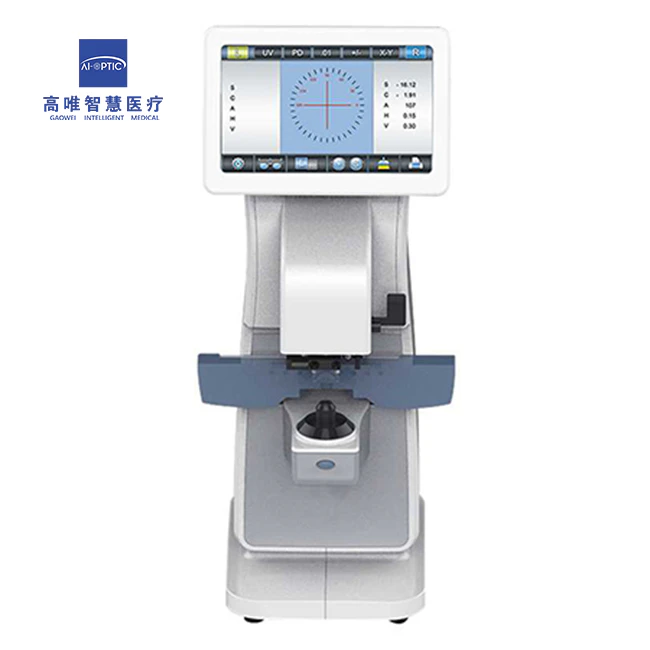
AL-1200 AUTO LENSOMETER
The AL-1200 also uses Hartmann measurement technology and a 7-inch touchscreen. It supports progressive, polarized, high-index, soft contact, and hard contact lenses. Its listed sphere range reaches ±25 D, while addition reaches ±10 D. Gaowei Vision AL-1200 specifications, accessed September 16, 2026.
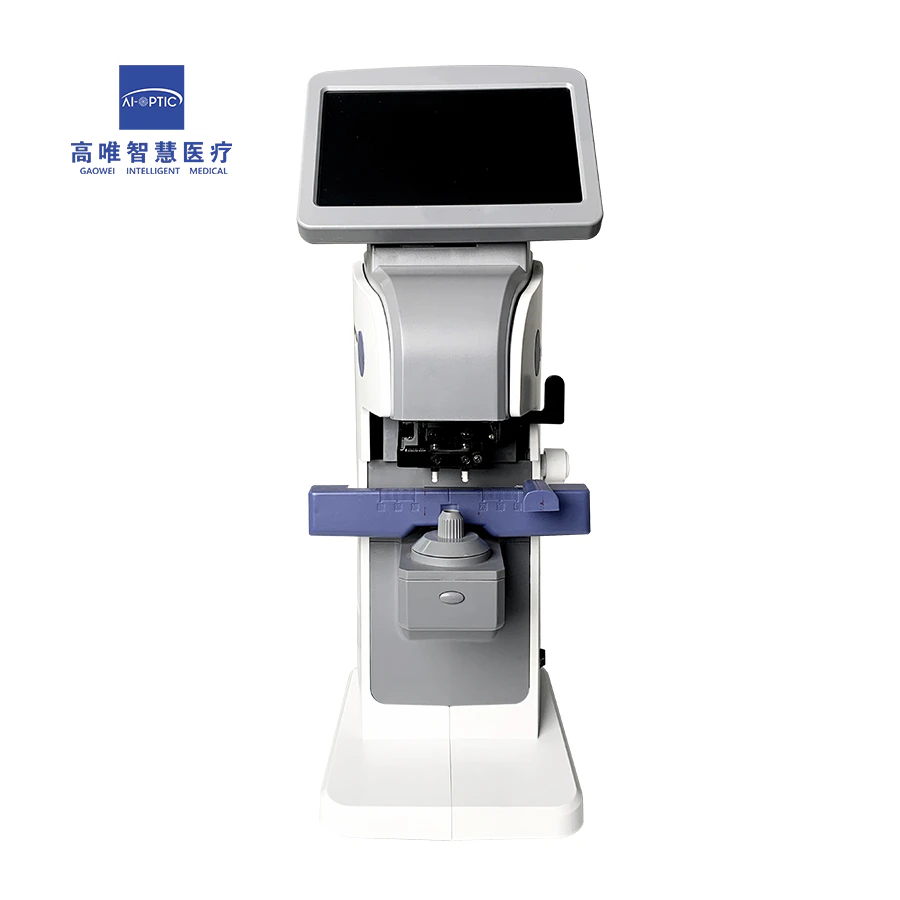
These specifications do not establish which model is budget or premium. Ask for comparable quotations, included accessories, a demonstration, warranty terms, and confirmation that any data connection works with your existing software.
FREQUENTLY ASKED QUESTIONS
Is a budget auto lensmeter accurate enough?
Yes, budget auto lensmeters are highly accurate for general use, typically meeting or exceeding clinical standards. Inside the standard prescription range where roughly 95% of patients fall (between -6.00D and +5.00D), budget digital options deliver excellent repeatability and remove human subjectivity from the reading.
Can an affordable model measure progressive lenses?
Yes. Many affordable models support progressive lenses. Test several corridor designs and small frames before buying.
How often should an auto lensmeter be checked?
An automatic lensmeter should undergo an empty-stage zero check daily, a reference lens accuracy check weekly, and a professional manufacturer service calibration annually. Check it sooner after relocation, impact, unusual readings, or failed repeatability tests.
Is a built-in printer necessary?
No. A printer is useful when paper records are required. Digital transfer or manual recording may be more practical in other workflows.
What should a warranty cover?
Confirm parts, labor, shipping, remote support, repair times, and post-warranty spare parts. Written terms are more useful than a general warranty claim.
Conclusion
For most small optical shops, a dependable budget auto lensmeter offers the best value when it handles the normal lens mix and includes competent support. A premium model is the better choice for heavy workloads, difficult lenses, useful software connections, or costly downtime. Test both options, calculate total ownership cost, and buy the lowest-priced configuration that meets those needs.


